
Digital Origination Is Reaching Its Next Constraint
The last decade of lending transformation focused heavily on digitising origination. Applications moved online, documents became electronic and integrations reduced some of the manual work involved in verification and underwriting.
The progress was significant. But many lenders are now discovering that a digital loan origination system can still be operationally slow.
A new product may take months to configure. A credit policy change can wait for an IT cycle. Underwriters still spend time moving between reports and systems to assemble context. The workflow is digital, yet the institution’s ability to change and decide remains constrained.
AI-native loan origination is emerging as a response to this next bottleneck.
AI-Native Is Not the Same as Adding AI Features
A platform does not become AI-native because a model, assistant or document tool is added to an existing workflow.
An AI-native loan origination system is designed so that intelligence can participate across the operating flow: interpreting documents, organising data, surfacing risk context, helping translate policy intent and prioritising exceptions.
The distinction matters. In a conventional architecture, AI produces an output and hands it back to the workflow. In an AI-native architecture, the workflow itself can respond to interpretation and context.
This does not remove human control. Lending decisions require governance, explainability and clearly defined accountability. The purpose of intelligence is to prepare better context, automate deterministic work and direct human attention to the decisions where judgement matters.
Velocity Comes from Removing Translation Layers
One of the largest sources of delay in lending is translation.
The business describes a product. Technology translates it into configuration. Credit writes policy. A technical team converts policy into rules. An underwriter interprets data from several sources before reaching a decision.
Each translation layer introduces time and the possibility of ambiguity.
AI can reduce some of these gaps. Natural-language configuration can help authorised users express intent more directly. Document intelligence can convert unstructured information into usable data. Decision support can bring relevant variables and exceptions into a single context.
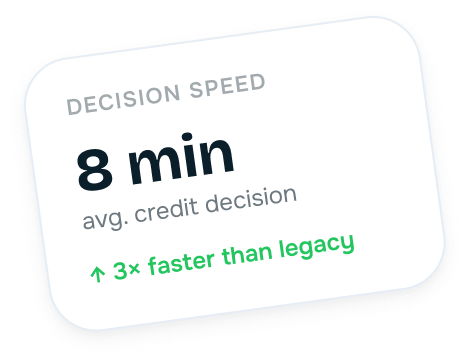
The velocity gain does not come from making a model think thirty times faster. It comes from removing the waits, hand-offs and repetitive assembly work surrounding the decision.
From Straight-Through Processing to Intelligent Exception Processing
Traditional automation often aims for straight-through processing. Applications that meet predefined conditions move automatically, while the rest enter manual review.
AI-native origination makes the exception layer more important.
Not all exceptions deserve the same attention. One application may be missing a document. Another may contain conflicting cash-flow signals. A third may sit just outside policy but show characteristics that justify deeper review.
An intelligent platform can help classify and prioritise those situations, giving underwriters more useful context before they begin.
The objective is not to automate every loan. It is to make every unit of human credit attention more productive.
The Competitive Advantage Is the Ability to Change
The long-term value of an AI-native LOS may be measured less by what it can do on implementation day and more by how quickly the institution can adapt after go-live.
Credit markets move. New borrower segments emerge. Risk teams learn from portfolio behaviour. Regulations evolve. A lending platform has to absorb those changes without repeatedly returning the institution to lengthy development cycles.
This is the real velocity shift: moving from a platform that executes a fixed digital workflow to infrastructure that helps the institution continuously interpret, configure and improve how origination works.
The next generation of loan origination systems will not be judged only on faster applications. They will be judged on how quickly the lender itself can learn and move.