
Small and medium enterprises are central to economic growth, but access to timely working capital remains one of their most persistent constraints. Traditional commercial lending often asks an SME to leave the systems where it runs its business, assemble documents, complete a separate application and wait while a lender reconstructs its financial position from static information.
Embedded finance for SMEs changes that model. Instead of treating credit as a standalone banking journey, it brings financing into the enterprise resource planning systems, procurement platforms, distributor portals and B2B marketplaces where commercial activity already takes place. The lending opportunity appears in context—when a business raises an invoice, purchases inventory, receives a confirmed order or needs to pay a supplier.
For lenders, the significance goes beyond convenience. An embedded model can create a more efficient distribution channel, provide access to operating data closer to the moment of need and support financing structures in which the use and repayment of funds are easier to track. Done well, it can help institutions serve smaller businesses with greater relevance, stronger controls and more sustainable unit economics.
Why Traditional SME Lending Does Not Scale
The economics of conventional SME lending are difficult. Relationship managers often source borrowers individually, underwriting teams review information from multiple sources and operations teams manage repeated follow-ups. These activities may be justifiable for a large commercial facility, but they can make smaller, short-tenor loans expensive to originate and service.
The information problem is equally important. Financial statements, bureau reports and bank records remain useful, but they are largely historical. They may not reveal whether order volumes are rising, whether a buyer has approved an invoice, whether inventory is moving or whether a supplier relationship is becoming more concentrated. By the time the lender has assembled a complete view, the working-capital need may have changed.
Digitising the application form reduces some friction, but it does not solve the distribution or data problem. The borrower still has to enter a separate lending journey, and the lender still has to assess the business from outside the operating context that created the need for finance.
What Embedded Finance Means in an SME Context
Embedded finance is the delivery of a financial product within a non-financial digital experience. In SME lending, this can mean offering credit inside an accounting application, inventory platform, procurement network, logistics portal or B2B marketplace. Embedded lending is the credit component of that broader model; embedded supply chain finance applies the approach to transactions between buyers, suppliers, distributors and dealers.
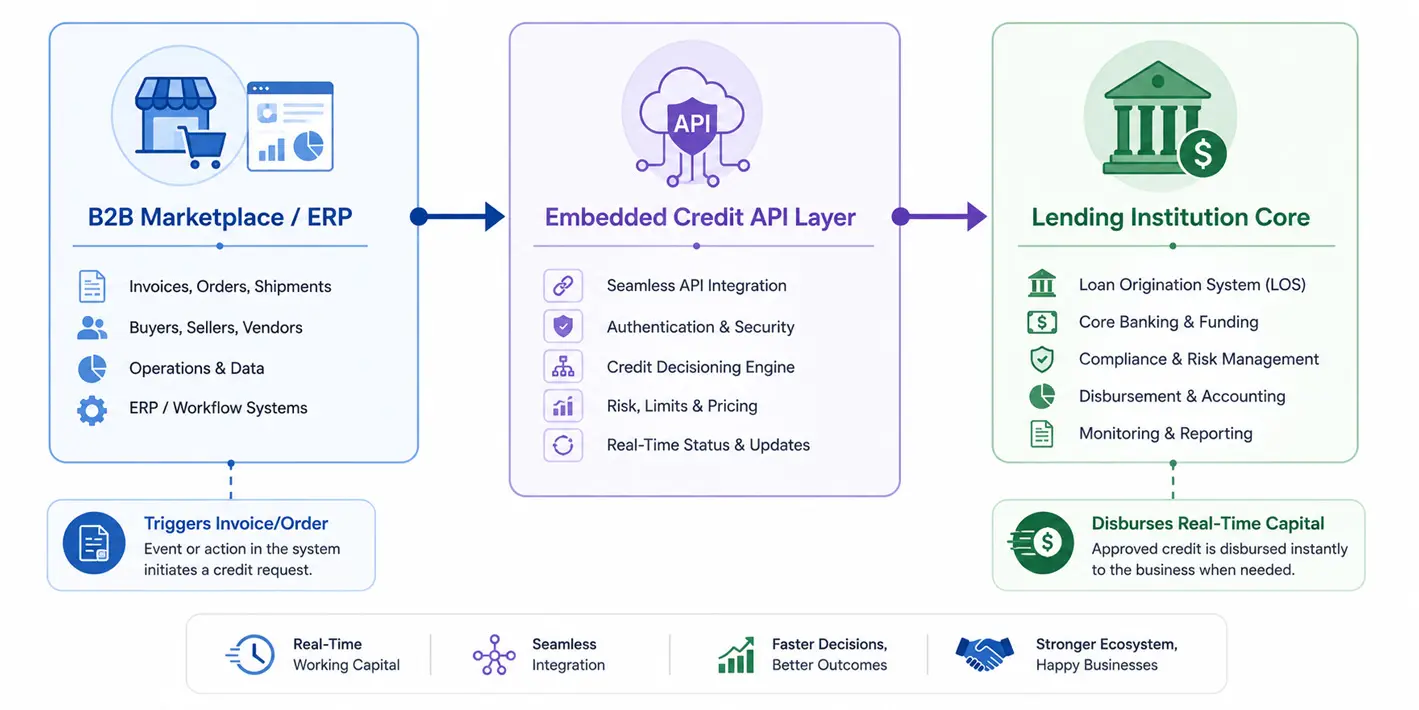
A typical journey begins when a commercial event triggers eligibility. A confirmed purchase order, approved invoice, inventory requirement or supplier payment creates a financing opportunity. With the necessary consent, the platform sends relevant transaction and business information through an integration layer to the lender. The lender applies its policy, risk controls and pricing logic, then returns an offer within the same experience. If the business accepts, funds can be routed to the relevant party and repayment linked to the underlying transaction.
The important change is not simply that an API has replaced a form. Credit is being designed around a verified commercial event rather than around an isolated application.
How Embedded Operating Data Can Improve Credit Assessment
The strongest embedded-finance propositions are built on data that has a clear relationship to the transaction being financed. Depending on the platform and the borrower’s consent, a lender may be able to consider signals such as:
- Order fulfilment velocity and the consistency with which the business completes confirmed orders.
- Invoice approval status, payment history and the quality or concentration of the buyer network.
- Transaction frequency, recent sales trends, inventory movement and seasonality.
- Returns, cancellations, disputes and other indicators that may affect expected cash flow.
These signals should complement – not automatically replace – financial, bureau, identity and policy checks. Their value is recency and context. They can help the lender understand how the business is operating now, while traditional sources help establish history, obligations and overall financial capacity.
This creates the possibility of underwriting a short-term facility against a specific commercial need, with limits, tenor and pricing aligned to the transaction and the institution’s risk appetite. The quality of the outcome still depends on data integrity, appropriate model governance and human oversight for cases that require judgement.
Closed-Loop Capital Can Strengthen Control
In a conventional working-capital loan, funds may be deposited into the borrower’s general account, after which the lender has limited visibility into their use. Embedded supply chain finance can support a more controlled flow of capital. In payables finance, for example, the lender may pay an approved supplier directly on behalf of the buyer. In receivables finance, funding can be tied to eligible invoices and repayment routed through a designated collection structure.
This does not eliminate credit, fraud or operational risk. It can, however, improve the link between the facility, the underlying commercial transaction and the movement of funds. That visibility can support stronger monitoring, earlier exception management and clearer reconciliation.
A More Scalable Distribution Model for Lenders
Embedded finance can also change acquisition economics. A partnership with a B2B network or enterprise platform may give a lender access to an ecosystem of businesses that already use the platform for regular commercial activity. The platform provides context and distribution; the lender retains responsibility for credit policy, compliance, pricing and the financial product.
When eligibility, data exchange, decisioning, documentation, disbursement and servicing are orchestrated digitally, the operational effort required per facility can fall. That can make smaller ticket sizes more viable, provided the programme has sufficient transaction volume, sound risk controls and a clear commercial model between the lender and platform partner.
The advantage is therefore not “free” customer acquisition. Partnerships require integration, governance, partner management and ongoing monitoring. The opportunity lies in replacing repeated one-to-one sourcing with a repeatable ecosystem channel.
Governance Must Be Designed into the Model
Embedded lending places the financial product inside a third-party journey, but responsibility cannot become ambiguous. Institutions need clear controls for customer consent, data use, identity verification, disclosures, pricing, grievance handling and the division of responsibilities between the platform and lender.
Data security and resilience are equally important. Access should be proportionate to the credit purpose, integrations should be monitored and critical decisions should remain traceable. Where models or automated rules influence eligibility, institutions should be able to explain the basis of the outcome, review exceptions and update policies without losing auditability.
A scalable programme therefore requires more than APIs. It needs configurable products and workflows, partner-specific controls, strong data orchestration, reliable reconciliation and a governance model that works across the full lifecycle of the facility.
Why Embedded Finance Is Becoming the Future of SME Lending
Embedded finance for SMEs does not remove the fundamentals of lending. Institutions still need disciplined underwriting, appropriate pricing, portfolio monitoring and regulatory compliance. What changes is where the lending journey begins and how closely it is connected to the commercial activity being financed.
For SMEs, the benefit is access to working capital at a relevant moment, without recreating their business history in a disconnected application. For platforms, finance can strengthen participation and transaction completion. For lenders, the model can create a scalable route to new borrowers, better operating context and more controlled capital deployment.
The institutions best positioned to capture the opportunity will be those that can combine flexible product design, API-first integration, intelligent decisioning and lifecycle controls—without compromising accountability.
Build Embedded Working-Capital Programmes That Can Scale
Uncia Flow helps financial institutions configure and manage supply chain finance programmes across buyers, suppliers, dealers and ecosystem partners. Explore how API-first, configurable infrastructure can bring working capital closer to the commercial events that create the need for it.