
Selecting a loan origination system is one of the most consequential technology decisions a bank or lending institution will make. The platform will influence how quickly products reach the market, how consistently credit policies are executed, how easily data and models can be integrated and how much operational effort is required to move an application from interest to disbursement.
The challenge is that most platforms can support a polished demonstration. The more useful evaluation is whether the underlying loan origination system features will continue to support the institution after implementation—when policies change, volumes rise, new data sources are introduced and the business expands into additional products or markets.
This checklist groups 15 essential capabilities across architecture, decisioning, scalability, operations and governance. It is designed to help banks and other lenders evaluate more than the visible borrower journey and examine the infrastructure that will determine long-term adaptability.
What Makes a Modern Loan Origination System (LOS)?
A modern loan origination system is more than a digital application and workflow tool. It should orchestrate data, verification, policy, decisioning, documentation, exceptions and user activity across the complete origination journey. It should also allow authorised teams to adapt products and rules within controlled boundaries rather than turning every change into a development project.
The right architecture will vary by institution, product and jurisdiction. However, the strongest platforms share a common objective: they bring data, decisions and workflow together while preserving explainability, security and operational control.
Core Architecture and Integration
1. Headless Architecture and API-First Design
The orchestration layer should be decoupled from the user interface so institutions can support different borrower, partner and employee experiences without duplicating core lending logic. Well-documented APIs should allow the LOS to exchange data and actions with channels, core systems, identity services, bureaus, document platforms and other components of the lending stack.
Why it matters: Channels and customer expectations change faster than core credit processes. A headless, API-first design allows institutions to evolve the experience without repeatedly rebuilding the lending engine.
2. Native Data Orchestration
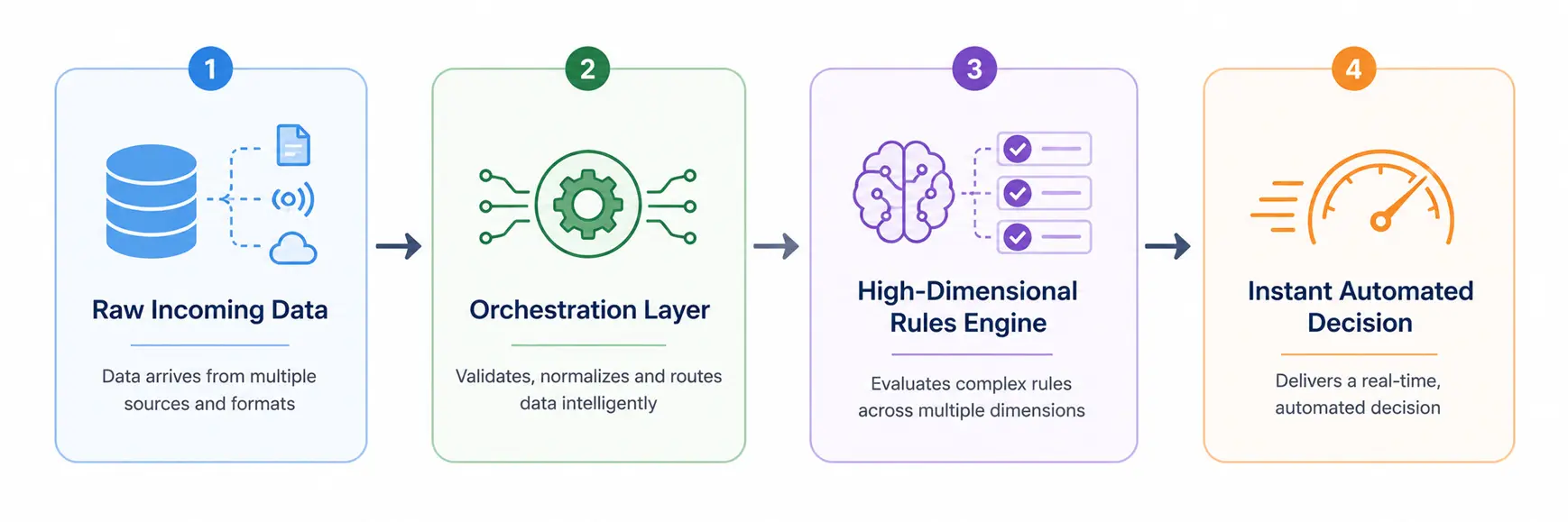
Modern underwriting depends on information from internal systems, credit bureaus, identity networks, fraud tools, bank-statement services and alternative sources. The LOS should ingest, validate, map and normalise these inputs before making them available to rules, models and users.
Why it matters: Without orchestration, every new source creates custom integration work and inconsistent data handling. A governed data layer reduces duplication and gives decisioning components a reliable input.
3. Low-Code Workflow Configuration
Authorised product and operations teams should be able to configure stages, routing, checklists, user roles and selected journey logic through a visual interface. Changes should move through approvals, testing and version control rather than bypassing governance.
Why it matters: Routine business changes should not wait in an engineering queue. Configuration shortens response time while preserving a clear boundary between business control and technology ownership.
4. Extensible Data Model
The platform should support new fields, entities and relationships without requiring a redesign of the core database for every product variation. It should accommodate structured and unstructured information while maintaining clear definitions, lineage and access controls.
Why it matters: New products, partners and regulatory requirements introduce new information. An extensible data model allows the platform to evolve without creating fragile side tables or disconnected data stores.
Decisioning and Risk Automation
5. Configurable Business Rules Engine
The rules engine should support eligibility, pricing, policy checks, verification outcomes, limit assignment, routing and exception logic. It should allow authorised changes with effective dates, approvals, testing, versioning and a complete history of which rule set influenced each decision.
Why it matters: Credit strategy changes frequently. A configurable engine helps institutions execute policy consistently and quickly while retaining auditability.
6. Model Integration and Controlled Deployment
Risk teams should be able to integrate statistical and machine-learning models through appropriate interfaces or supported model formats. The platform should manage model versions, inputs, outputs, approvals, monitoring and fallback behaviour when a model or data source is unavailable.
Why it matters: Model accuracy is only one part of production decisioning. Institutions also need controlled deployment, traceable use and the ability to change or withdraw a model safely.
7. Intelligent Exception Routing
Applications outside straight-through parameters should be routed according to the reason for the exception, required expertise, authority level and service target. Underwriters should receive the relevant context rather than a generic work item.
Why it matters: Automation does not eliminate exceptions. Good routing protects specialist capacity, reduces avoidable handling and ensures judgement is applied where it adds value.
Multi-Entity and Enterprise Scale
8. Multi-Entity, Multi-Product and Multi-Currency Support
Institutions operating across business units or markets need clear separation of legal entities, products, users, policies, currencies and accounting treatments within a shared technology environment. Configuration should support reuse where appropriate and isolation where required.
Why it matters: Growth should not require a separate platform for every entity or product. A scalable structure reduces duplication while respecting local operating and governance needs.
9. Localisation and Regulatory Configuration
The LOS should support market-specific disclosures, consent, data-residency controls, identity requirements, documentation, language and retention rules. Local variation should be configurable without forcing institutions to fragment the core architecture.
Why it matters: Compliance requirements differ across jurisdictions and evolve over time. Configurable localisation helps institutions adapt while maintaining a controlled global foundation.
10. Co-Lending and Syndication Support
Where the business model requires it, the platform should support partner eligibility, allocation logic, participation structures, document flows, approvals and data exchange across originating and participating institutions.
Why it matters: Risk-sharing structures introduce operational complexity. Native support reduces manual reconciliation and makes partner responsibilities more transparent.
Operations, Borrower Experience and Governance
11. Omnichannel Journey Continuity
Applicants should be able to move between mobile, web, assisted and partner channels without losing progress or creating duplicate applications. The platform should maintain state, consent and interaction history across the journey.
Why it matters: Borrowers rarely follow a perfectly linear path. Journey continuity reduces abandonment and gives employees or partners the context needed to assist effectively.
12. Automated Document Processing and Verification
The LOS should ingest relevant documents, extract data, classify files, apply validation checks and route low-confidence or inconsistent results for review. Human verification should remain available where accuracy, policy or regulation requires it.
Why it matters: Document handling is a common source of delay. Automation can reduce manual effort, but confidence thresholds and exception controls are essential for dependable use.
13. Granular, Real-Time Audit Trails
The platform should record automated calculations, model and rule versions, data-source responses, manual actions, field changes, approvals and overrides with timestamps and user identities. The audit record should be accessible without reconstructing events from multiple systems.
Why it matters: Explainability and accountability depend on evidence. A complete trail supports internal review, customer queries, model governance and regulatory examination.
14. Unified Product Catalogue
Product teams should be able to manage eligibility, limits, pricing, fees, repayment structures, documents and channel availability within a governed catalogue. Reusable components should reduce the need to rebuild common logic for every variant.
Why it matters: Product speed depends on how easily the institution can configure and reuse approved building blocks. A unified catalogue creates control without making change unnecessarily slow.
15. Operational and Technical Observability
Technology and business teams need visibility into system health, API latency, integration failures, queue volumes, exception rates, application drop-off and decision outcomes. Alerts and dashboards should support both immediate response and longer-term optimisation.
Why it matters: A lending journey can appear available while hidden failures damage turnaround time or conversion. Observability allows teams to identify the point of friction and act before it becomes a portfolio-wide issue.
Questions to Ask Every LOS Vendor
A useful proof of concept should test the platform against realistic change, integration and governance scenarios—not only a preconfigured happy path. Ask vendors to demonstrate:
- How an authorised business user changes a workflow or credit rule, and how that change is approved, tested, versioned and audited.
- How the platform integrates a new data provider and handles latency, missing data, retries and service failure.
- How a decision can be reconstructed, including the data, rule set, model version, manual action and override that influenced it.
- How the product supports local variation, entity separation, data residency and role-based access.
- Which capabilities are configuration, which require code and which depend on the vendor’s professional-services team.
- How implementation is phased, how data migration is managed and how business users are prepared to own post-go-live change.
- How performance, security, resilience and recovery are tested at the institution’s expected scale.
Evaluate the Platform You Will Need After Go-Live
The best loan origination software is not necessarily the platform with the longest feature list. It is the platform that can support the institution’s credit strategy, operating model and governance requirements as they evolve.
During evaluation, ask vendors to configure a representative product, connect a real or simulated third-party service, introduce an exception and then change a rule. This reveals how the platform behaves when the business moves beyond a scripted demonstration.
A modern LOS should help the institution make decisions faster, launch products with greater control and adapt without accumulating a new layer of digital legacy. Those outcomes—not a successful demo—are the more meaningful buying criteria.
Explore Configurable, AI-Native Loan Origination
Uncia Prime brings workflow configuration, data orchestration, intelligent decisioning and API-first integration into a unified loan origination platform. Explore how the right architecture can give lending teams greater speed without giving up control.