
An NBFC can originate loans successfully and still struggle to maintain complete records of its Lending Service Providers and Digital Lending Apps, track Default Loss Guarantee exposure, or furnish required information through RBI reporting channels. The system may approve loans, but the surrounding controls and data may not keep pace with digital-lending obligations.
Quick Answer
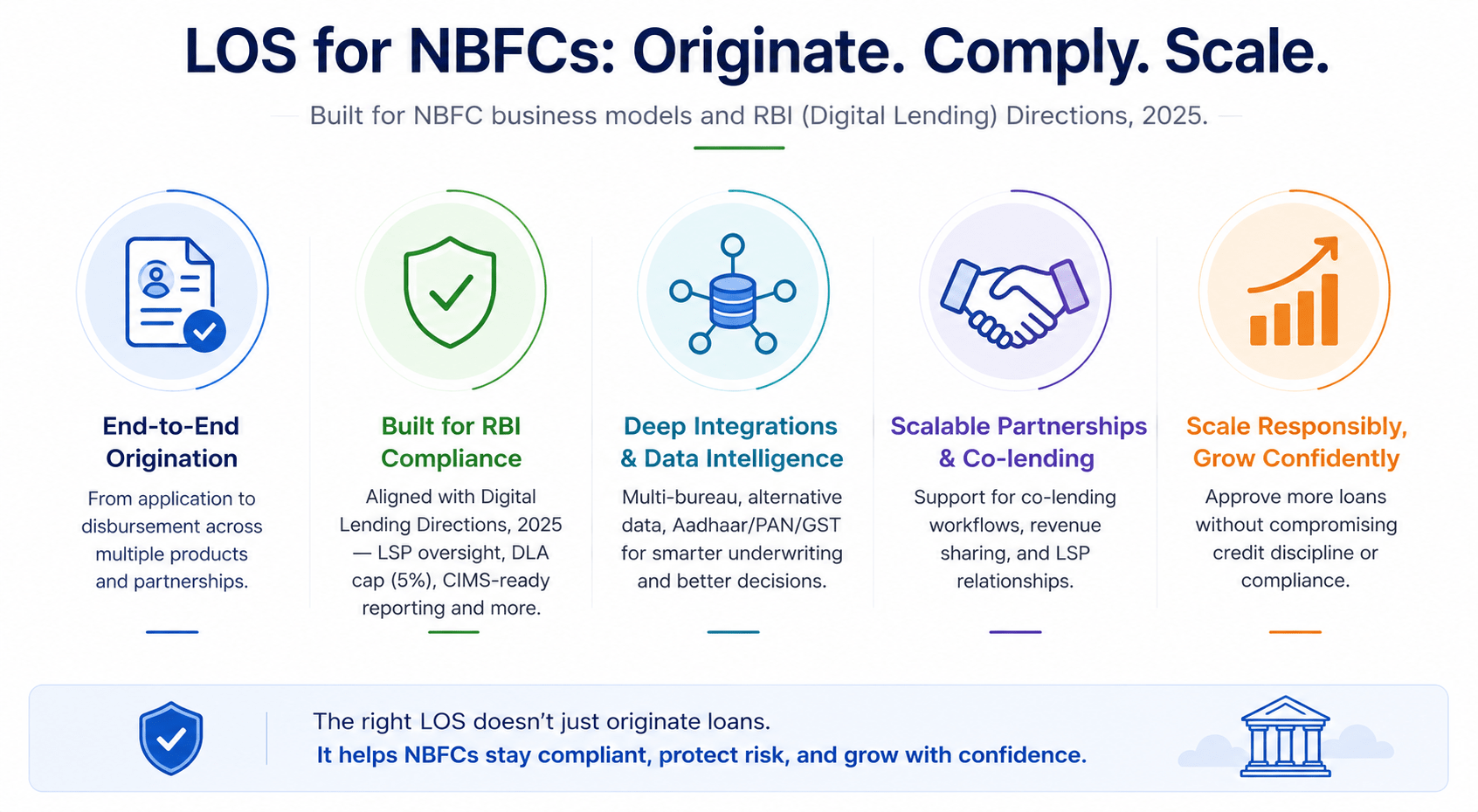
A loan origination system (LOS) for an NBFC manages the journey from application to disbursement while supporting the institution’s product mix, distribution partnerships, underwriting model, and regulatory obligations. Many NBFCs need multi-bureau and alternative-data integration, co-lending support, configurable products, and controls aligned with the Reserve Bank of India (Digital Lending) Directions, 2025. Selection should focus on regulatory fit, operational configurability, integration depth, and the ability to scale without weakening credit discipline.
Why NBFCs Need a Purpose-Built LOS
Banks and NBFCs both originate loans, but they don’t operate the same way. NBFCs typically serve thinner-file borrowers, run more product variety per institution, and lean heavily on partnerships, co-lending with banks, tie-ups with Lending Service Providers (LSPs), and embedded lending through fintech platforms. A LOS built primarily for a bank’s product mix and compliance posture often can’t flex into these models without significant customization.
That mismatch can have the fastest effect in compliance. NBFCs face a specific, fast-evolving set of regulatory obligations that a generic LOS, or one built for a different market entirely, simply wasn’t designed around.
What’s Changed: RBI’s Digital Lending Directions, 2025
The RBI consolidated years of separate circulars into a single framework, the Reserve Bank of India (Digital Lending) Directions, 2025, issued in May 2025. For an LOS, it defines what the system has to be able to do.
The Directions apply to regulated entities engaged in digital lending, including covered NBFCs. Among other requirements, they prescribe direct flow of funds between the regulated entity and the borrower, subject to specified exceptions; due diligence and ongoing oversight of Lending Service Providers; controls over Digital Lending Apps; and limits and conditions for Default Loss Guarantee arrangements, including a 5% cap linked to the specified loan portfolio. RBI has also operationalised a public DLA directory using information furnished by regulated entities through CIMS. An LOS should capture the data and approvals needed to support these obligations rather than leave them to disconnected manual processes.
Core Features an Loan Origination System for NBFCs Should Have
| Feature | Why It Matters for NBFCs |
| Multi-bureau integration | NBFCs often serve borrowers with thin or no credit history, requiring multiple bureau and alternative data sources, not just one |
| Co-lending workflow support | Co-lending arrangements with banks need shared underwriting logic, exposure tracking, and revenue-sharing calculations built into the workflow |
| LSP and DLA compliance tooling | Automated due diligence records, contract tracking, and CIMS-ready reporting for every LSP relationship |
| FLDG and DLG tracking | Real-time visibility into guarantee exposure against the 5% regulatory cap, across every loan and every partner |
| Aadhaar, PAN, and GST-based underwriting | Faster, more accurate borrower verification and income assessment, especially for MSME and thin-file borrowers |
| Multi-product configurability | Support for the product variety NBFCs typically run, from gold loans to unsecured personal loans to MSME lending, without separate systems for each |
| Regional language support | Borrower-facing workflows that work outside metro, English-first markets |
Why Growth Is Making This Urgent
NBFC retail portfolios continue to expand, but the pace and composition vary by product and institution. ICRA’s sector outlook projected continued growth in retail assets under management, excluding housing finance companies, with expansion increasingly concentrated in secured segments such as gold loans and loans against property amid greater attention to asset quality.
The combination of strong growth and asset quality caution puts real pressure on origination systems. An LOS needs to approve more loans without loosening underwriting discipline, do it across a shifting product mix, and stay on track as compliance requirements get stricter.
Benefits of a Modern LOS for NBFCs
- Faster approvals without sacrificing underwriting quality. Automated bureau pulls, GST-based income verification, and configurable credit policies cut manual review time without cutting corners.
- Lower application drop-off. A borrower journey built for mobile-first, lower-bandwidth users, common in the segments many NBFCs serve, keeps more applicants through to disbursement.
- Compliance built into the workflow, not layered on top. LSP due diligence records, DLG tracking, DLA information, and compliance evidence are captured as part of the workflow rather than assembled through a separate manual exercise.
- Support for co-lending at scale. As co-lending volumes grow, a system that handles shared underwriting and exposure tracking natively avoids reconciliation errors between partners.
- Room to grow into new products. Adding a new loan product shouldn’t require a new system, just new configuration within the same one.
Selection Criteria Checklist
Before shortlisting vendors, it’s worth confirming:
- Does the system have live reference clients running similar loan products and volumes among NBFCs specifically, not just banks?
- How current is the vendor’s compliance mapping to the RBI’s Digital Lending Directions, 2025, and how quickly do they update it when RBI issues new guidance?
- Can co-lending workflows handle multiple bank partners with different underwriting requirements without custom development for each?
- What does bureau and alternative data integration actually cover, and does it include the data sources most relevant to thin-file borrowers?
- How is DLG exposure tracked against the applicable portfolio cap, and can the institution retrieve the supporting data and approvals quickly?
The Bottom Line
An LOS for an NBFC cannot be evaluated only as a generic bank-origination system with different branding. It must fit the NBFC’s products, partnerships, underwriting methods, operating geography, and applicable RBI obligations. As portfolios and distribution models expand, the strongest systems are those that treat configurability, credit control, compliance evidence, and scale as connected requirements.