
The traditional approach to credit risk management is hitting a wall. For decades, lending institutions relied on linear credit bureau scores, static rules engines, and historical financial statements to evaluate creditworthiness. While this framework provided a baseline level of stability, it created rigid boundaries. Applicants who fell just outside the standard parameters were rejected, while hidden risks within approved portfolios went unnoticed.
Many institutions attempted to solve this by layering artificial intelligence onto their existing legacy infrastructure. However, this bolted-on approach introduces systemic friction. A legacy platform equipped with an isolated machine learning plugin is not truly agile. To unlock genuine competitive advantages, modern lending institutions are moving toward AI-native loan origination systems.
An AI-native platform is not merely an old system with smarter analytics. It is an infrastructure built from the ground up to ingest, orchestrate, and act on complex data ecosystems in real time.
The Structural Difference: Bolted-On vs. AI-Native
To understand how credit decisioning is shifting, leaders must distinguish between an upgraded legacy platform and an indigenous AI architecture.
| Feature | Bolted-On AI Platforms | AI-Native Origination Systems |
| Data Ingestion | Batch processing; restricted to structured inputs. | Continuous streaming; ingests structured and unstructured data. |
| Model Execution | Offline model training with slow, manual deployment cycles. | Real-time execution with automated, monitored feedback loops. |
| Decisioning Engine | Hardcoded waterfall logic with limited variables. | High-dimensional risk scoring across thousands of data points. |
| System Flexibility | Requires extensive engineering support for minor rule changes. | Configurable pipelines allowing risk teams to iterate independently. |
Legacy systems process information sequentially. They check a credit score, run basic KYC verification, and apply binary rule sets. If a borrower requires a more nuanced evaluation, the application stalls or falls into a manual underwriting queue.
AI-native infrastructure removes these operational bottlenecks. It treats data ingestion and decisioning as a singular, fluid process. By orchestrating data concurrently rather than sequentially, these platforms analyze thousands of variables simultaneously without increasing processing latency.
Redefining Risk through Multidimensional Data
The primary value of AI-native decisioning lies in its capacity to evaluate risk through a wider lens. Standard underwriting models typically evaluate a handful of core variables, such as payment history, outstanding debt, and length of credit history.
AI-native platforms expand this scope exponentially. By integrating alternative data streams naturally, these systems evaluate cash flow patterns, transactional velocity, utility payment consistency, and sector-specific macroeconomic indicators.
For small and medium enterprise (SME) lending, this shift is transformative. An AI-native system can connect directly to a business applicant’s accounting software, e-commerce platform, and bank APIs. Instead of looking at a static tax return from twelve months ago, the underwriting engine assesses the business’s current financial health. It identifies seasonal revenue spikes, customer concentration risks, and day-to-day cash reserves. This level of granularity allows risk officers to price loans accurately based on actual performance rather than historical averages.
Continuous Model Refinement and Feedback Loops
In traditional environments, updating a credit model is a major operational project. Data scientists build a new model, risk committees review it over several weeks, and engineering teams spend months recoding the core banking system to deploy it. By the time the new model goes live, market conditions have frequently changed.
AI-native underwriting solves this deployment lag through continuous feedback loops. The system constantly monitors loan performance against initial underwriting assumptions. If a specific segment of the portfolio shows an unexpected uptick in early-stage delinquencies, the system flags the pattern immediately.
This gives risk leadership a major tactical advantage. Instead of waiting for quarterly loan reviews to reveal portfolio degradation, teams can adjust credit policies in real time. They can tighten specific parameters or expand criteria for high-performing segments within days, protecting unit economics and preserving capital.
Operational Efficiency and the Bottom Line
Beyond improving risk accuracy, AI-native decisioning fundamentally alters the operational cost structure of a lending institution. Manual underwriting is expensive and slow. By automating complex decisioning pathways, an AI-native system handles the vast majority of applications without human intervention. When a file does require a manual review, the platform surfaces the exact anomalies that triggered the flag, allowing human underwriters to make faster, better-informed decisions.
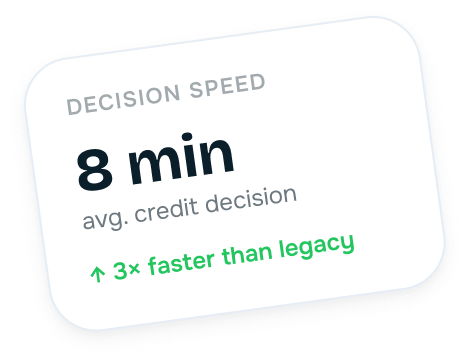
This efficiency directly impacts customer acquisition costs. In a market where borrowers expect instant gratification, the institution that delivers an accurate, binding offer first usually wins the business. AI-native loan origination allows institutions to scale their loan volumes safely without needing to scale their operational headcount at the same rate.
The Strategic Path Forward
Transitioning to AI-native credit decisioning is not just a technological upgrade; it is a strategic necessity for institutions looking to defend their market share. The future of lending belongs to organizations that can price risk with precision, adapt to macroeconomic shifts instantly, and deliver frictionless borrower experiences. By replacing rigid, siloed legacy infrastructure with an architecture designed for the data realities of today, financial leaders can unlock sustainable growth while keeping risk firmly under control.