
Lenders often frame this as a replacement choice: retire the rules engine, implement an AI model, and move forward. Supervisory bodies increasingly treat the two approaches differently. AI and rule-based underwriting have distinct strengths, limitations, and governance requirements; they are not simply two stages on a single upgrade path.
Quick Answer
Rule-based underwriting applies fixed, transparent criteria to each application. It is easy to explain and audit, but it cannot identify patterns beyond the logic it has been given. AI underwriting can analyse broader datasets and surface risk signals that static rules may miss, but it creates additional requirements for explainability, validation, monitoring, and human oversight. The right approach depends on the use case and the consequences of the decision. For high-impact credit decisions, lenders need particularly strong governance and a clear route for human review. In practice, many institutions use both approaches together.
What Rule-Based Underwriting Actually Does Well
Rule-based systems apply the same criteria (such as income thresholds, debt-to-income ratios, and credit score cutoffs) to every application. The logic is precise by design, allowing anyone to trace exactly why an application was approved or denied.
This transparency is not just a compliance requirement. It is also a genuine advantage. A rules engine is straightforward to audit and simple to explain to a borrower or a regulator. While it always behaves in a predictable manner, it can only detect what it was explicitly designed to catch. A borrower whose risk profile does not match the rulebook, such as someone with irregular but healthy cash flow, might be declined by a system that can’t recognize their situation.
Where AI Underwriting Pulls Ahead
The Financial Stability Board‘s June 2026 consultation report on responsible AI adoption highlighted several examples of how AI can support underwriting differently, not simply more quickly.
In one case study, a regional bank’s machine learning models tracked small and medium-sized enterprise (SME) borrowers for early signs of cash flow issues. The models identified over 95% of loans that would eventually go non-performing, at least three months before the businesses missed a payment. More than 80% of the borrowers flagged early were able to recover from default risk instead of being written off. A rules-based system that only checked payment history would have flagged most of these cases only after significant damage occurred.
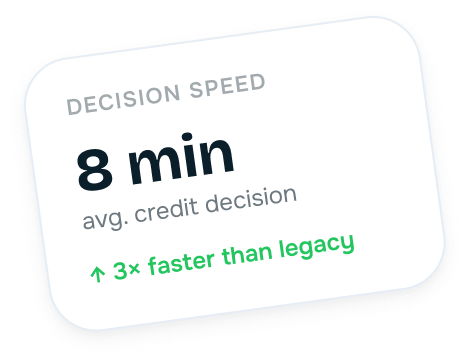
In another example, a bank created a generative AI tool to assist with SME credit underwriting. It automated data extraction and created credit narratives for human reviewers. The result was promising. The system achieved over 80% accuracy in extracting financial data, and credit approvers found more than 70% of its output to be useful. The time taken for a preliminary credit proposal dropped from over a day to about 15 minutes. The system also matched manual reviewers in spotting data inconsistencies and fraud signals in each case tested.
In a nutshell, the advantage of AI underwriting is that it can detect risk earlier and process information faster.
The Real Trade-off: Performance and Explainability
The FSB’s guidance clearly states the trade-off: more complex, higher-performing AI models are generally harder to explain than simpler ones. Striking the right balance varies from case to case.
The appropriate standard depends partly on how a model’s output is used. An AI system that flags a transaction for further investigation creates a different risk from a model that independently determines whether a borrower can access credit. Credit decisions directly affect access to funds, so lenders should expect a higher standard of explainability, validation, oversight, and recourse.
This doesn’t exclude AI from underwriting. It means that AI used for credit decisions requires the appropriate governance: documented reasoning, audit trails, human oversight at crucial points, and a strategy for when the model cannot be fully explained.
Rule-Based vs. AI Underwriting: A Comparison
| Rule-Based Underwriting | AI Underwriting | |
|---|---|---|
| Explainability | High, every decision traceable to a fixed rule | Varies, often requires specific explainability tooling |
| Speed at scale | Fast, but limited by the rules written | Can process much more data per decision, often faster overall |
| Pattern detection | Only catches what the rules specifically check for | Can reveal risk signals the rules were never designed to capture |
| Governance burden | Lower, logic is static and easy to audit | Higher, needs ongoing monitoring, testing, and documentation |
| Best fit | High-volume, standardized products with clear risk criteria | Complex or thin-file borrowers where alternative data adds real signal |
Where Each Approach Actually Belongs
Neither system is a universal winner, and many lenders do not need to choose one exclusively:
- Rules still lead where consistency is crucial. Products with stable, well-understood risk criteria, and where regulators require fully traceable decisions, tend to be better served by clear rules than by a model that is harder to explain.
- AI excels where the data offers more than the rulebook can apply. SME lending, thin-file borrowers, and situations where alternative data like cash flow patterns provide real insight tend to see AI underwriting perform much better than static criteria.
- Hybrid setups are becoming increasingly common. Many of the most successful examples in the FSB’s report combine an AI model with human review at the decision point. This setup combines AI’s ability to detect patterns with a rules-based or human-reviewed layer for accountability.
What Global Regulators Expect From Either Approach
Regardless of which approach a lender uses, supervisory expectations converge on a few consistent points: clear documentation of how a use case works and why it was chosen, appropriate testing and monitoring based on the significance of the decision, and human oversight that matches the model’s autonomy and risk. A rules engine generally meets these requirements by default. An AI model must be designed to fulfill them intentionally.
The Bottom Line
Rule-based underwriting is not outdated, and AI underwriting is not a blanket upgrade. The FSB’s proposed sound practices point to a more useful question than “which one is better”: how consequential is the decision, and does the chosen method provide the explainability, validation, oversight, and governance required? Lenders that answer that question use case by use case will often arrive at a hybrid model, allowing each approach to operate where it is best suited.